When conventional monetary policy tools—such as adjusting benchmark short-term interest rates—reach their limits (for instance, when rates are near zero), central banks turn to unconventional monetary policy tools: Quantitative Easing (QE) and Quantitative Tightening (QT). Because forex markets are heavily driven by capital flows, interest rate expectations, and liquidity, shifts between QE and QT create…

Author: admin
Safe-Haven Currencies: Trading the USD, JPY, and CHF in Crises
During periods of global financial turmoil, geopolitical conflict, or sudden economic shocks, global risk appetite collapses. In these Risk-Off regimes, institutional capital flees high-beta and growth-oriented assets (like stocks and commodity-linked currencies) to seek capital preservation in safe-haven currencies. The primary safe-haven assets in the foreign exchange market are the U.S. Dollar (USD), the Japanese…
What is Economic Calendar Trading and How to Read It
Economic Calendar Trading is the practice of planning, placing, or managing financial market trades based on scheduled macroeconomic events and news releases. Because central bank monetary policies and national economic reports directly drive institutional capital flows, an economic calendar acts as a global master schedule for traders. It lists upcoming data releases (such as inflation…
How Commodity Prices Influence Currency Movements (CAD, AUD, NZD)
In the foreign exchange market, certain national economies rely heavily on the production and export of raw materials. The currencies of these nations are known as commodity currencies. The three most prominent examples are the Canadian Dollar (CAD), the Australian Dollar (AUD), and the New Zealand Dollar (NZD). Because these countries export vast quantities of…
Understanding Risk-On vs. Risk-Off Market Sentiment
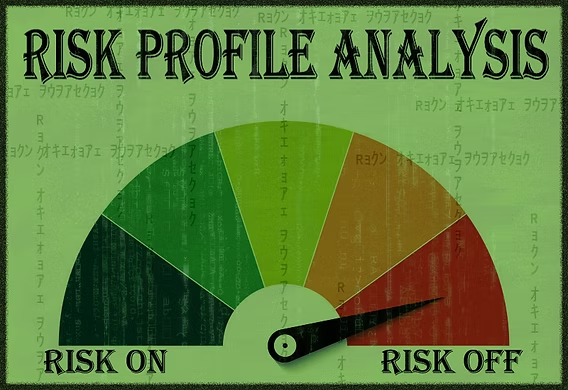
Understanding Risk-On vs. Risk-Off Market Sentiment Financial markets do not always move based on individual balance sheets or economic releases in isolation. Frequently, the underlying catalyst driving prices across forex, equities, commodities, and bonds is market sentiment—the collective mood and risk appetite of global institutional investors. In trading terminology, this overarching mood shifts between two…
What is Geopolitical Risk in Forex and How to Trade Around It?
In foreign exchange trading, geopolitical risk refers to the potential for political conflict, international tension, military action, elections, or trade policy shifts to alter economic stability and cause rapid disruptions in currency valuations. Unlike macroeconomic releases (like CPI or non-farm payrolls), which follow scheduled release calendars, geopolitical events often occur with minimal advance warning. During…
How Inflation and Consumer Price Index (CPI) Affect Forex Prices
In the foreign exchange market, inflation and the Consumer Price Index (CPI) are among the most critical economic drivers monitored by traders, analysts, and institutional investors. Because inflation directly dictates how central banks adjust interest rates, monthly CPI releases routinely spark intense volatility across global currency markets. What is Inflation and the Consumer Price Index…
Trading Non-Farm Payrolls (NFP): Strategies and Risk Management
The Non-Farm Payrolls (NFP) report is released on the first Friday of every month by the U.S. Bureau of Labor Statistics. It measures the net change in U.S. employment (excluding farm workers, private household staff, and non-profit employees) and is widely considered the most volatile single news event in the forex market. Because the Federal…
How Central Bank Interest Rates Impact Currency Values
Interest rates represent the cost of borrowing money and the return earned on savings, set by a nation’s central bank. Among all macroeconomic variables, prevailing interest rates exert the most profound influence on foreign exchange markets, dictating the long-term trends and short-term volatility of currency values. Understanding how central bank policy shifts drive these fluctuations…
Fundamental Analysis in Forex: Key Economic Indicators to Track
In foreign exchange trading, fundamental analysis evaluates the underlying economic, financial, and geopolitical forces that influence a nation’s currency value. While technical analysis focuses on price charts and patterns, fundamental analysis answers why a currency is strengthening or weakening. At the heart of forex fundamental analysis are economic indicators—statistical reports published periodically by government agencies…