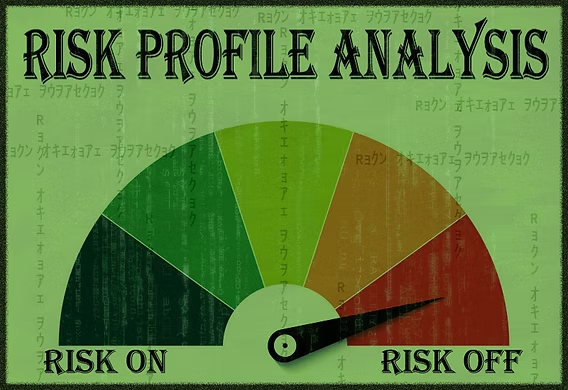
Understanding Risk-On vs. Risk-Off Market Sentiment
Financial markets do not always move based on individual balance sheets or economic releases in isolation. Frequently, the underlying catalyst driving prices across forex, equities, commodities, and bonds is market sentiment—the collective mood and risk appetite of global institutional investors.
In trading terminology, this overarching mood shifts between two primary regimes: Risk-On and Risk-Off. Recognizing which sentiment regime dominates the market is crucial for aligning your positions with institutional capital flows and avoiding trades that fight the prevailing tide.
What is Risk-On vs. Risk-Off?
At its core, risk sentiment reflects whether investors are primarily seeking growth and yield or prioritizing capital preservation.
+--------------------------------------------------------------------------+
|                        Market Sentiment Regimes                          |
+--------------------------------------------------------------------------+
|  RISK-ON (Optimism & Growth)       │  RISK-OFF (Fear & Uncertainty)     |
|  ---------------------------       │  ------------------------------     |
|  • Focus: Maximizing Yield         │  • Focus: Capital Preservation      |
|  • Drivers: Solid Economic Data,   │  • Drivers: Geopolitical Tension,   |
|    Rate Cuts, Corporate Growth     │    Slowing Growth, Inflation Shocks |
|  • Action: Buying High-Yield Assets│  • Action: Flying to Safe Havens    |
+--------------------------------------------------------------------------+
1. Risk-On Sentiment (Market Optimism)
In a Risk-On environment, market participants feel confident about global economic expansion, corporate revenue growth, and market stability.
-
Triggers: Dovish central bank policies (rate cuts), strong corporate earnings, robust GDP/employment figures, and geopolitical stability.
-
Investor Behavior: Capital flows out of low-yielding, defensive assets and into higher-beta, yield-seeking assets.
2. Risk-Off Sentiment (Market Caution/Fear)
In a Risk-Off environment, uncertainty or sudden negative shocks prompt investors to retreat from risky positions.
-
Triggers: Geopolitical conflicts, unexpected central bank rate hikes, weak economic indicators, or “black swan” systemic crisis events.
-
Investor Behavior: Capital flows into liquid, secure safe-haven instruments to protect principal capital from drawdowns.
Asset Behavior Across Sentiment Regimes
Understanding how different asset classes react allows traders to build a clear snapshot of market conditions:
| Asset Class | Risk-On Behavior | Risk-Off Behavior |
| High-Yield / Growth Forex | Appreciates: AUD, NZD, CAD, and Emerging Market pairs | Depreciates: Capital flees cyclical economy currencies |
| Safe-Haven Forex | Depreciates / Flat: JPY, CHF, and USD lag | Appreciates: JPY, CHF, and USD surge on safe-haven demand |
| Stock Indices (S&P 500, Nasdaq) | Rallies: Strong demand for equity growth | Declines: Broad sell-off across equity sectors |
| Sovereign Bonds & Yields | Yields Rise: Investors sell bonds to buy stocks | Yields Fall: Heavy bond buying drives prices up / yields down |
| Commodities (Oil, Copper vs Gold) | Oil & Copper Rise; Gold stalls | Gold Rallies; Industrial commodities drop |
Key Currency Sentiment Barometers

In the forex market, certain currency crosses act as real-time “thermometers” for global risk sentiment:
1. AUD/JPY (Australian Dollar / Japanese Yen)
-
Why It Works: Australia’s economy relies heavily on raw material exports and global trade growth (Risk-On), while the Japanese Yen is the premier funding and safe-haven currency (Risk-Off).
-
Reading the Pair: An uptrend in AUD/JPY confirms strong Risk-On sentiment, whereas a downtrend in AUD/JPY signals escalating Risk-Off anxiety.
2. CBOE Volatility Index (VIX)
-
Why It Works: Often called the “Fear Index,” the VIX measures expected 30-day volatility in the S&P 500.
-
Reading the Gauge:
-
VIX Below 15: Indicates calm, Risk-On market conditions.
-
VIX Above 20–25: Signals sharp Risk-Off fear and potential market liquidation.
-
Actionable Trading Framework
+--------------------------------------------------------------------------+
|                       Trading Strategy Guidelines                        |
+--------------------------------------------------------------------------+
| 1. Identify Dominant Regime: Check AUD/JPY, VIX, and Bond Yields.        |
| 2. Align Trades with Capital Flow:                                       |
|    • In Risk-On: Buy AUD/JPY, NZD/USD, or S&P 500 breakouts.              |
|    • In Risk-Off: Buy USD/JPY, CHF/AUD, or Gold (XAU/USD).               |
| 3. Manage Position Sizes: Reduce leverage during sharp VIX spikes.       |
+--------------------------------------------------------------------------+
-
Avoid Counter-Sentiment Trades: Never attempt to buy commodity currencies (like AUD or CAD) during an active Risk-Off news shock.
-
Watch the Bond Market First: Government bond yields often shift before stock markets or spot currency pairs reflect sentiment changes.
-
Use Intermarket Analysis: If equities are dropping, bond yields are falling, and gold is surging, the market is decisively Risk-Off—adjust your stop-loss distances and position sizing accordingly.