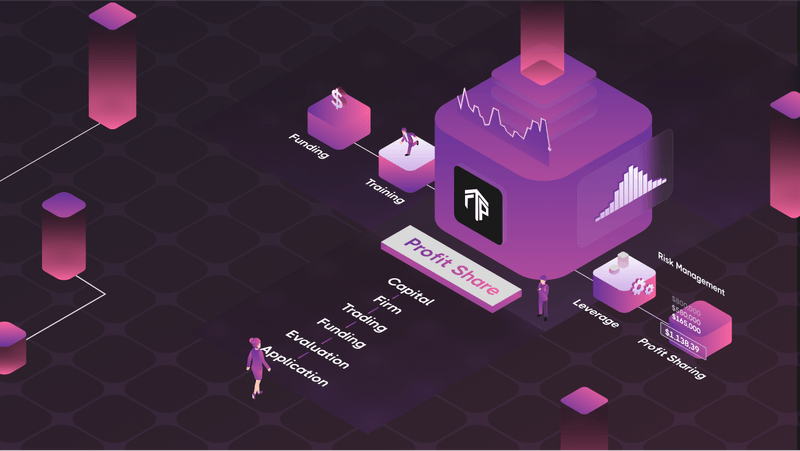
Proprietary trading firms (prop firms) allow traders to manage funded accounts ranging from $10,000 to over $400,000 in exchange for a profit split (typically 80% to 90% in favor of the trader).
Rather than depositing your own capital, you pay an evaluation fee to prove you can navigate strict risk parameters while generating steady returns.
Understanding Drawdown Models: The Make-or-Break Metric
How a prop firm calculates your maximum loss determines how much room your strategy actually has to breathe.
| Drawdown Type | How It Is Calculated | Strategy Impact |
| Static Drawdown | Fixed floor based on initial account balance (e.g., $100k account floor is set at $90k). | Highly forgiving for swing traders; room doesn’t shrink as equity grows. |
| Trailing Drawdown | Trailing floor that rises as your open or closed profits increase. | High pressure; locking in profits raises your loss floor, reducing draw buffer. |
| Balance-Based Daily | Resets daily based on 00:00 server starting balance. | Predictable daily risk buffer. |
| Equity-Based Daily | Tracks floating unrealized losses during active trades. | Floating drawdown can breach daily limits mid-trade during deep pullbacks. |
The Math of Reverse Position Sizing
Most traders fail evaluations because they trade for speed rather than survival. To pass safely, calculate position sizes based on Drawdown Buffer, not total account equity:
$$\text{Effective Risk Capital} = \text{Account Size} \times \text{Max Drawdown \%}$$
$$\text{Risk Per Trade} = \frac{\text{Effective Risk Capital}}{\text{Planned Consecutive Loss Buffer}}$$
Example: On a $100,000 account with a 10% ($10,000) max drawdown limit, your actual trading capital is $10,000, not $100,000. Risky sizing at 2% of the total account balance ($2,000 per trade) means just 5 losing trades will blow the account. Sizing at 0.5% ($500 per trade) gives you a 20-trade safety buffer.
5 Golden Rules to Retain Your Funded Account

-
Beware the Consistency Rule: Modern 2026 evaluations enforce consistency metrics—no single trading day should account for more than 30% to 40% of your total target profit.
-
Clear News Releases: Close positions or avoid entering 2 minutes before and after Tier-1 news releases (CPI, NFP, rate decisions) if your firm prohibits high-impact news trading.
-
Avoid Over-Leveraging First Days: Get to a $2R$ or $3R$ profit cushion on your funded account before attempting to scale lot sizes.
-
Log Performance Metric Signals: Track your average win rate, profit factor, and max intraday drawdown to spot strategy degradation early.
-
Treat it Like Institutional Capital: Prop firms look for consistent risk management over lucky home-run trades.