
Position trading Forex is a long-term approach where traders hold positions for several months to a year or more. Instead of focusing on short-term market fluctuations, position traders ride major macroeconomic trends driven by central bank interest rate differentials, inflation cycles, and structural economic shifts.
Position Trading vs. Other Forex Styles
Position trading behaves more like traditional macro investing, sacrificing trade frequency to capture massive multi-hundred or multi-thousand pip moves.
| Strategy Dimension | Position Trading | Swing Trading | Day Trading |
| Holding Horizon | Months to Years | Days to Weeks | Intraday (Hours) |
| Primary Drivers | Interest Rates & GDP | Technical Price Action | Intraday Momentum |
| Chart Timeframes | Weekly & Monthly | Daily & 4-Hour | 5-Min to 1-Hour |
| Target Profit | 500 – 2,000+ Pips | 100 – 300 Pips | 15 – 40 Pips |
| Account Leverage | Low ($1:1$ to $1:5$) | Moderate ($1:10$ to $1:20$) | High ($1:30+$) |
The Core Fundamental Drivers
-
Central Bank Interest Rate Differentials: Currency capital naturally flows toward currencies offering higher yield. Position traders buy high-interest currencies against low-interest currencies to capture both trend appreciation and long-term positive swap yield.
-
Economic Policy Divergence: Identifying when one central bank (e.g., the US Federal Reserve) is actively tightening monetary policy while another (e.g., the Bank of Japan) remains accommodative.
-
Macro Commodity Cycles: Trading commodity-linked currencies (like AUD, CAD, or NZD) alongside long-term supercycles in gold, crude oil, or industrial metals.
Technical Entry & Execution Strategy
While fundamentals dictate what to buy or sell, technicals determine when to execute:
  LONG-TERM MACRO ENTRY BLUEPRINT
  -----------------------------------------------------------------------
  1. Macro Bias: Confirm a strong fundamental divergence between two economies.
  2. Structure: Locate multi-year Support/Resistance on the Monthly chart.
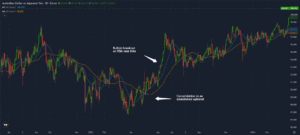
  3. Technical Trigger: Wait for a Weekly breakout or a retest of the 50-week EMA.
  4. Position Sizing: Use wide Stop-Losses (150–300 pips) placed beyond macro swing levels.
  5. Capital Allocation: Risk no more than 1% to 2% of total capital on low leverage.
  -----------------------------------------------------------------------
Managing the Carry Trade & Rollover
Because positions remain open across many financial quarters, managing interest rate swap is vital:
-
Positive Carry Advantage: Holding a long position on a higher-yielding currency earns daily interest credits (rollover), significantly boosting overall return on investment ($ROI$).
-
Negative Carry Trap: Avoid holding long-term position trades against the rate differential, as negative daily swap fees will erode profits over time.