Range trading is a strategy deployed when a financial market trades sideways between clear support floors and resistance ceilings. Rather than riding a directional macro trend, range traders profit by buying near the bottom (support) and selling near the top (resistance) until a breakout occurs.
1. Identifying a Valid Trading Range
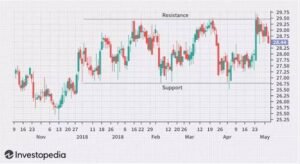
A market is considered range-bound when price bounces between horizontal boundaries without forming higher highs or lower lows.
                         TYPICAL RANGE BOUNDARY

  Resistance Level  ───┬───────────────┬───────────────┬─── (Sell Zone)
                      / \             / \             / \
                     /   \           /   \           /   \
                    /     \         /     \         /     \
  Support Level     ───┴───────────────┴───────────────┴─── (Buy Zone)
-
Minimum Touches: Require at least two touches at resistance and two touches at support to confirm a valid horizontal channel.
-
Low Trend Intensity: Confirm that the Average Directional Index (ADX) is below 20, indicating a non-trending environment.
2. Core Range Trading Strategies
Strategy A: The Oscillator Confirmation Bounce
This approach uses momentum indicators to confirm that price is exhausting itself as it hits a range boundary.
  OSCILLATOR BOUNCE BLUEPRINT
  -----------------------------------------------------------------------
  • Setup: Map horizontal Support and Resistance levels on 1-Hour / 4-Hour charts.
  • Buy Trigger: Price touches Support AND RSI drops below 30 (Oversold),
    then crosses back above 30.
  • Sell Trigger: Price touches Resistance AND RSI rises above 70 (Overbought),
    then crosses back below 70.
  • Exit Target: Opposing boundary or midpoint (50% range median).
  -----------------------------------------------------------------------
Strategy B: The Liquidity Sweep (Fakeout Rejection)
Institutions often push price briefly past key support or resistance to trigger stop-loss orders before driving price back into the range.
-
Trigger: Wait for a candle wick to breach support or resistance, followed immediately by a candle closing back inside the range boundary.
-
Execution: Trade the reversal back toward the middle or opposite side of the channel, placing your stop-loss just beyond the wick high/low.
3. Execution & Risk Management Parameters
| Parameter | Execution Rule | Strategic Purpose |
| Entry Point | Near boundaries (outer 10–20% of range) | Avoids chop in the middle of the range |
| Stop-Loss | Placed 10–20 pips outside the outer boundary | Protects against a true breakout |
| Primary Target | Opposing support/resistance line | Captures maximum available range expansion |
| Secondary Target | Mid-range (50% distance) | Lock in partial profits early |
4. How to Spot an Impending Breakout
Range trading becomes high-risk when momentum builds for a directional breakout. Exit range strategies when you observe:
-
Higher Lows into Resistance: Buyers are aggressively pushing price higher on every dip, building pressure against the ceiling.
-
Volume Expansion: Trading volume surges as price approaches the boundary.
-
ADX Rising Above 25: Signals that trend strength is developing.